Chorus
Every chorus is a delay line whose length wobbles. The fork in the road is how many delay lines, and whether they wobble together.
One line, one LFO, and you hear the wobble as wobble: pitch swims up and down, and the effect announces itself. That's a chorus, and sometimes a chorus is what you want. But run three or six lines from LFOs at offset phases and sum them through a sign matrix, and the pitch modulation largely cancels in the middle while the differences pile up at the edges. The swim disappears. What's left is width — everything sounds bigger and more expensive, and you can't point at what's moving.
That second architecture is what the famous rack-mount string ensembles did, and what the celebrated 1980s Japanese four-button stereo chorus inherited from them. If that wide, unwobbling spread is what you're after, one plugin on the device is built the same way:
Our pick: String machine stereo chorus
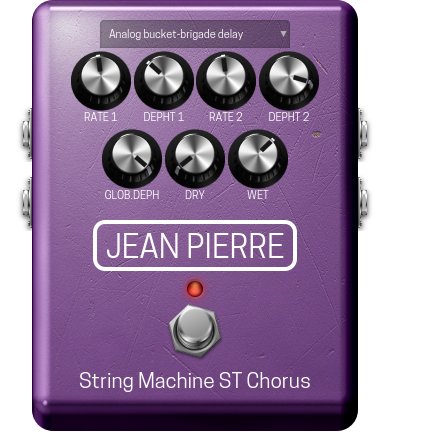
String machine stereo chorus is a direct descendant of the string-ensemble circuit. It runs two independent LFO rows, three phases each (0°, 120°, 240°), and sums the six delay lines through a sign matrix — L = line1 + line2 − line3, R = line1 − line2 − line3. That matrix is the whole trick. The result is wide, lush, and open, with a slow, organic motion.
The slow LFO row defaults to 0.6 Hz, well under the 1 Hz that separates "breathing" from "wobbling." The modulation is razor-thin (5 ms base, ±1 ms), so the pitch stays stable while the image opens up. An analog mode runs a 185-stage bucket-brigade model with clock-rate modulation, adding the warm, slightly compressed coloration of real BBD hardware.
| Rate 1 | Depth 1 | Rate 2 | Depth 2 | Global Depth | Mode |
|---|---|---|---|---|---|
| 6 Hz | 30% | 0.6 Hz | 40% | 50% | Analog |
Place it after your drives and before delay and reverb, and listen as your riffs take up more space.
New to loading plugins? See Plugins & Effects for how to browse and add them in MOD-UI.
Also great: C* Wider - Stereo image Synthesis
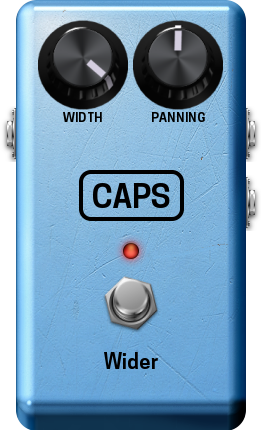
C* Wider is the opposite approach: pure static width, no motion at all. It synthesizes a side signal through three allpass filters and matrixes it into stereo. Instant width, zero warble, zero chorus.
What you give up: No movement — this is a photograph, not a film. Try stacking it before String machine stereo chorus: Wider at 0.6 for the image floor, with the ensemble breathing on top.
If you want the wobble
Nothing above is a chorus in the sense most players mean. If you want the effect to be audible — the shimmer on a clean arpeggio, the thickening under a lead — reach for a single-LFO stereo chorus and turn the depth up. TAP Chorus/Flanger is the most controllable of these: one cosine LFO shared between channels with an adjustable 0–180° phase offset (default 90°), depth topping out near 2.3 ms, plus a highpass "Contour" on the wet path that keeps the low end from smearing. Set Freq to 1–2 Hz and Depth high and it does exactly what it says.
Gx chorus is the simpler version of the same idea: one sine LFO per channel at a fixed 90° offset, default rate 3 Hz. At its default depth (±0.2 ms) it's nearly inaudible; open it up and it chorusses cleanly. No matrix, so it sounds chorused before it sounds wide.
Also considered
C* Chorus I is mono, and a mono chorus cannot produce width — it can only produce wobble. Excellent single-voice DSP (cubic-interpolated delay, a 250 Hz highpass ahead of the line) with feedforward and feedback controls that take it into flanger and slapback territory. Use it as a mono thickener, not a widener.
SWH Multivoice Chorus is mono, and its LFO bottoms out at 2 Hz. It also does something unusual: up to eight voices modulated by sinc-interpolated random envelopes rather than deterministic sines, which avoids the metallic ring multi-voice choruses get. It shimmers rather than breathes. Interesting for thickening a mono source.
rkr Flanger/Chorus is the ZynAddSubFX chorus as wrapped by rakarrack: one delay line, one LFO, and a toggle that shortens the delay range into flanger territory. Nothing here that TAP or Gx chorus doesn't do, and no matrix.
Not yet researched
We've read the source for seven of the fifteen chorus-family plugins on the device. The following have not been introspected, and any of them could displace a pick above:
| Plugin | Bundle | Why it might matter |
|---|---|---|
| Calf Multi Chorus | calf.lv2 |
Multi-voice by name. If the voices are phase-offset it belongs in the width discussion |
| Triple chorus | fomp-labs.lv2 |
Three voices. Check for a sign matrix |
| CS Chorus 1, CS Chorus 2 | fomp-labs.lv2 |
Unknown topology; two variants implies a real difference |
| ZynChorus | ZynChorus.lv2 |
Standalone build of the ZynAddSubFX chorus |
| String machine chorus | string-machine-chorus.lv2 |
The mono sibling of our pick. Same matrix? Or just one line? |
| Airwindows Vibrato | Airwindows-Vibrato.lv2 |
Chris Johnson. Vibrato is chorus without the dry signal; worth knowing what it does |
| MDA Detune | mod-mda-Detune.lv2 |
Pitch-shift thickening rather than delay modulation — a third architecture entirely |
fomp.lv2 and fomp-labs.lv2 ship the same plugin URIs from two different builds. The device loads the -labs build; research those bundles, not their plain siblings.
Credits
| Plugin | Author | License | Homepage |
|---|---|---|---|
| String machine stereo chorus | Jean Pierre Cimalando | GPL-2.0+ | github.com/jpcima/string-machine |
| C* Wider - Stereo image Synthesis | Tim Goetze / MOD team | GPL-2.0+ | github.com/moddevices/caps-lv2 |
| TAP Chorus/Flanger | Tom Szilagyi | GPL-2.0 | tap-plugins.sf.net |
| Gx chorus | Guitarix team | ISC | guitarix.sourceforge.net |
| C* ChorusI | Tim Goetze / MOD team | GPL-2.0+ | github.com/moddevices/caps-lv2 |
| SWH Multivoice Chorus | Steve Harris | GPL-2.0+ | github.com/swh/lv2 |
| rkr Flanger/Chorus | Nasca Octavian Paul (ZynAddSubFX) | GPL-2.0 | github.com/ssj71/rkrlv2 |