pi-Stomp Manual
The complete guide to the pi-Stomp ecosystem — from building your first kit to developing custom plugins and contributing to the open-source project.
In this manual
- About — The people and mission behind pi-Stomp
- Product Overview — The software stack and the three terms the rest of the manual uses
- Building — Obtaining hardware, assembly, and software installation
- Using — Navigation, pedalboards, plugins, MIDI, and configuration
- Maintenance — Troubleshooting, performance tuning, backups, and recovery
- Developers — Architecture, code structure, and contributing
- Plugins — Editorial reviews of the best open-source effects
Spot a mistake? Select any text on a page and click Suggest edit to fix it straight on GitHub. See Editing this manual for details.
What is pi-Stomp?
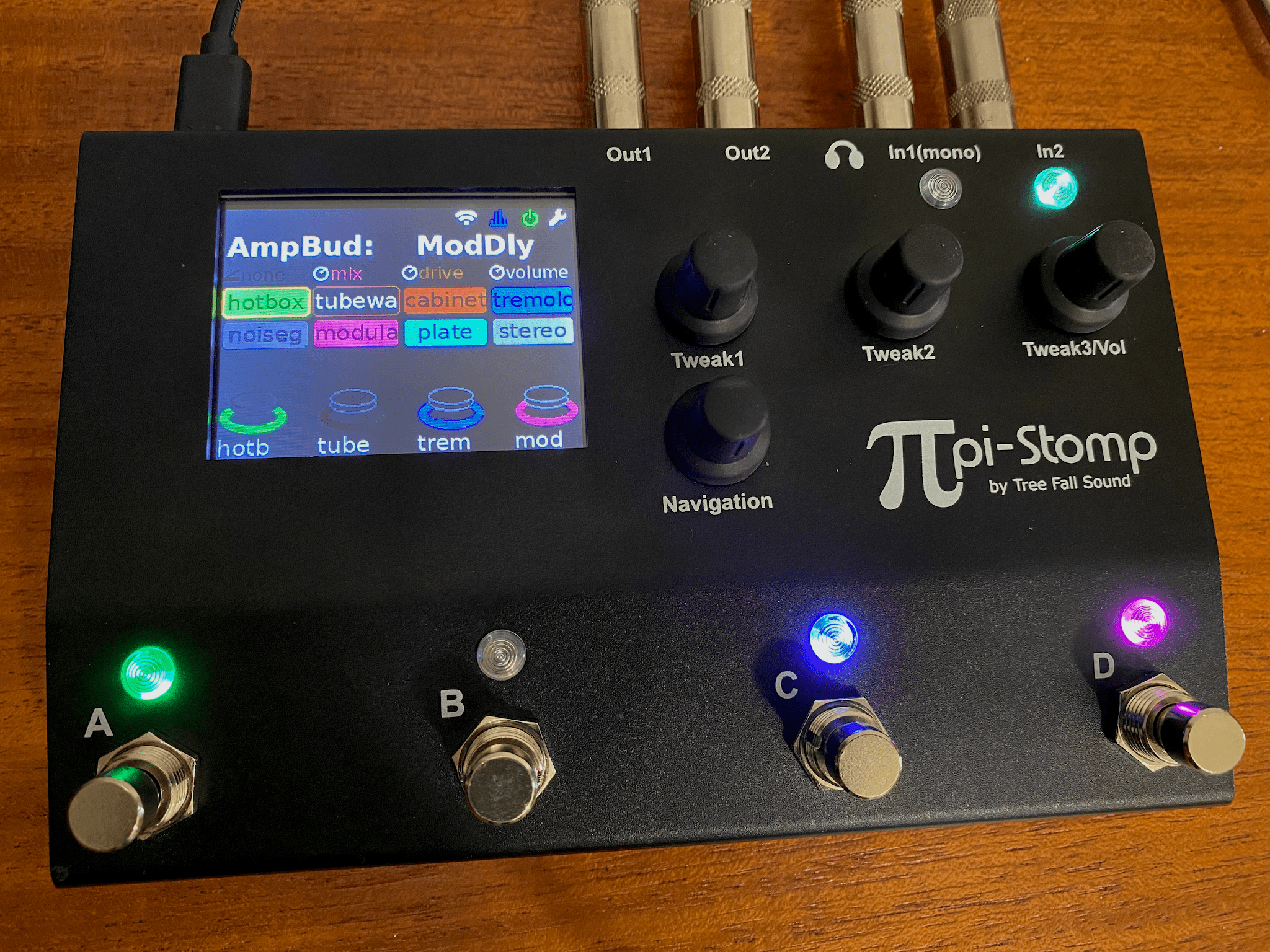
pi-Stomp is a DIY high-definition multi-effects platform for guitar, bass, and keyboards.
Built on top of the Raspberry Pi, it runs 600+ open-source LV2 effects, Neural Amp Models (NAM), and 60+ synth/drum machine/sampler plugins, all controllable from the hardware front panel or a web browser. LV2 is the open plugin format the Linux audio world standardized on — the same role VST plays elsewhere — which is why there are so many effects to draw on and why anyone can write another.
You build pedalboards in a browser and play them from the floor. Setup needs a computer once; after that, none on stage.
| Version | Status | Pi | Build | Controls | LCD |
|---|---|---|---|---|---|
| v3 | Current | Pi 5 | Solderless kit | 4 footswitches, 3 tweak encoders | 2.8" color TFT |
| v2 | Supported | Pi 3/4 | Through-hole | Up to 5 footswitches, 1 encoder | Color TFT |
| v1 | Unsupported | Pi 3 | Through-hole | 3 footswitches | Monochrome |
The current OS image does not run on v1 hardware — the software has no v1 class and exits on startup.
All pi-Stomp software is free open source (AGPL-3.0). Join us on GitHub: we'd love to hear your feature requests / bug reports and welcome code contributions.
About Tree Fall Sound
Tree Fall Sound exists to bring multi-effects projects to DIY musicians.
Founded by Randall Reichenbach, the pi-Stomp project is our passion: a high-quality, open, affordable multi-effects platform for the music community. Every kit is assembled, tested, and shipped by hand. Over 300 kits have been built in 25+ countries.
Learn more about the people behind pi-Stomp on the About page.