Analog Polysynth
If you want warm, drifting, two-hands-on-the-keys analog pads and brass under your guitar rig, six virtual-analog polysynths ship on the device. We read the DSP source of all six (see research/24-analog-polysynth-bakeoff.md), and one of them models an analog filter at the circuit level while the rest stay clean and digital:
Our pick: Obxd
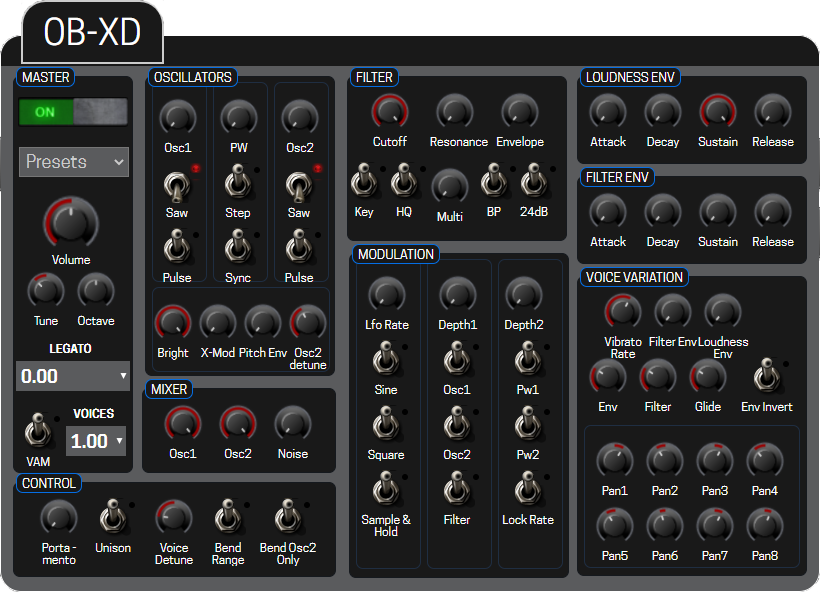
Obxd is Filatov Vadim's model of a famous late-'70s American two-oscillator polysynth — the fat, blooming pads and brass stabs that sound expensive before you touch a knob. The filter is why: a zero-delay feedback structure with a Taylor-approximated diode-pair nonlinearity (Filter.h:82-106), switchable between a 12 dB multimode (with a low/band/high Multimode blend) and a 24 dB cascade with tanh damping. It is the only filter in this bake-off that models analog nonlinearity at the circuit level; every other contender runs a clean digital filter.
The drift is the other half of the character. Each of the 8 voices gets its own random detune factors — envelope, filter, portamento, and level all scatter slightly per voice (ObxdVoice.h:159-163), so held chords shimmer instead of sitting still. Voice Detune scales the effect. There is also a unison mode that stacks all 8 voices on one note, hard sync, cross-modulation, and optional 2× oversampling. 27 factory presets ship in MOD-UI — enough to hear the range, though you'll want to dial your own.
| VoiceCount | Osc1Saw | Osc2Saw | Oscillator2detune | VoiceDetune | Cutoff | Resonance | FilterEnvAmount |
|---|---|---|---|---|---|---|---|
| max (8) | on | on | 0.1–0.2 | 0.2–0.3 | 0.4–0.5 | 0.1–0.2 | 0.2–0.4 |
All Obxd ports are normalized 0–1. Start there for a pad, then lower Cutoff and raise FilterEnvAmount for brass. At 8 voices we estimate ~280 multiply-adds per sample — comfortably inside the safe zone alongside a guitar chain, and an economy mode skips silent voices.
Place it at the head of its own chain — instrument plugins take MIDI in, not audio. See MIDI Instruments for how to plug in a keyboard, and Plugins & Effects for loading plugins in MOD-UI.
Also great: amsynth
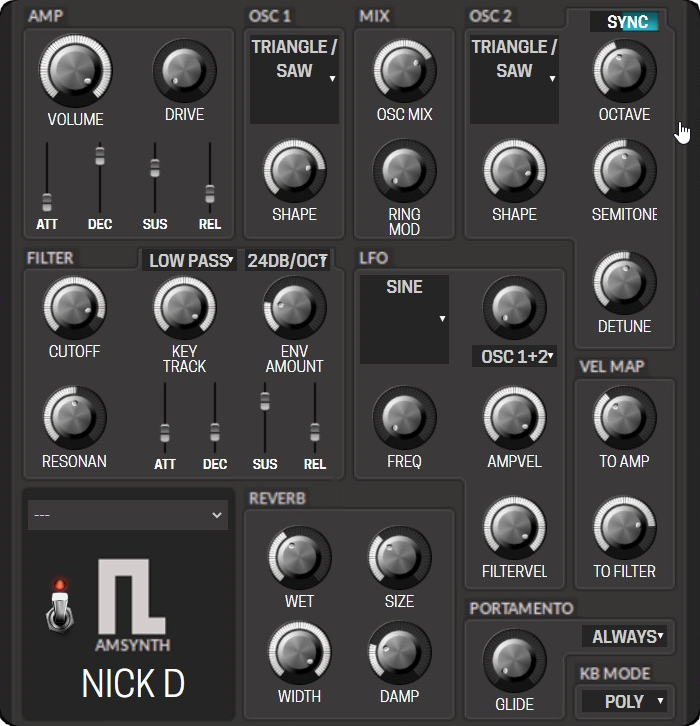
amsynth is the dependable one: Nick Dowell's synth has been in continuous development since 2001, and it is the lightest real polysynth here (~35 multiply-adds per voice, ~350 at its default 10 voices — and polyphony is configurable, all the way to unlimited). Two oscillators with ring mod and hard sync, a multimode filter with 12/24 dB slopes, two ADSRs, one LFO. 27 factory presets ship in MOD-UI, and the control surface is the smallest of the three contenders — Filter Cutoff, Filter Resonance, Osc2 Detune, and Osc Mix map onto pi-Stomp encoders without a cheat sheet.
What you give up: the filter is a clean SVF/biquad cascade — no diode modeling, no zero-delay feedback. The result is tighter and more polite than Obxd; the character has to come from your playing and the ring mod. Pick it when you want a polysynth running all night next to a full guitar chain and never think about CPU.
Also great: Helm
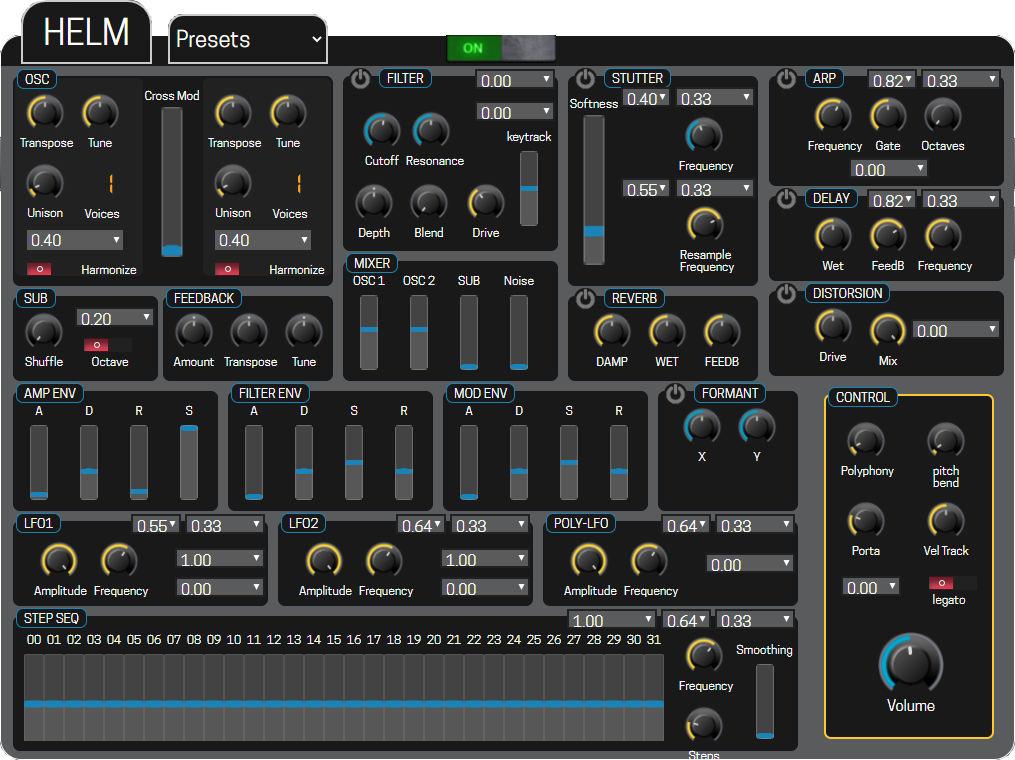
Helm is the deep one. Matt Tytel's semi-modular synth has a full polyphonic modulation matrix, two LFOs plus a step sequencer, a 4-pole ladder filter and a 4-formant vowel filter, cross-modulation, a sub oscillator, and up to 15 unison voices per oscillator. Nothing else on the device routes modulation like this — if your patch idea starts with "and then the step sequencer sweeps the formant," Helm is the only answer. And you don't have to program any of it yourself: 274 factory presets ship in MOD-UI, by far the largest bank in this bake-off.
What you give up: headroom. Unison cost scales linearly (~10 multiply-adds per unison voice on top of a ~40 base), so 8 voices with 7-voice unison lands around ~880 — nearly double the ~500 budget that coexists with a guitar chain on a Pi. Keep polyphony under 8 and unison low, or give Helm the whole board and mix your guitar in dry.
Also considered
Noise Maker - ME is Patrick Kunz's synth in a MOD Devices port, and per voice it is arguably the best-equipped here: three oscillators with hard sync to a dedicated master oscillator, ring mod, a bitcrusher, 12 filter types (including a ladder-style 24 dB mode) running 4× oversampled, and 24 factory presets. But PMAX_VOICES = 4 — four voices total, hard-capped in the build. That is a lead and duo-line synth; pads run out of fingers. If mono/duo is your use, it beats everything above.
Triceratops does fat three-oscillator unison — BLEP anti-aliased saws with per-oscillator unison, built-in echo and reverb, and a healthy 82 factory presets. The on-device build allows 12 voices, and at ~50 multiply-adds per voice that is ~600 total at full polyphony — past the budget next to a guitar chain. Usable if you cap your playing at 6–8 voices, but Obxd gives you more character for less CPU.
Wolpertinger is not a subtractive VA at all: its resonant bandpass filter tracks the played note (cutoff = param_cutoff * freq, synth.cpp:79), so the filter follows the pitch in a fixed ratio — a hollow, vocal, bouncing character closer to a tuned resonator than a VCF. Interesting, but it can't make the pads and brass this page is about — and it ships zero presets, so you start from a blank panel.
Two near-misses on scope: Calf Monosynth is monophonic by design, and MDA JX10 — the classic warm supersaw — is a pad machine more than an analog-poly stand-in; it deserves its own write-up.
Credits
| Plugin | Author | License | Homepage |
|---|---|---|---|
| Obxd | Filatov Vadim (2DaT / Datsounds) | GPL | github.com/2DaT/Obxd |
| amsynth | Nick Dowell | GPL | amsynth.github.io |
| Helm | Matt Tytel | GPL-3.0 | tytel.org/helm |
| Noise Maker - ME | Patrick Kunz (TAL), ported by MOD Devices | GPL | tal-software.com |
| Triceratops | Nick Bailey | GPL-3.0 | github.com/thunderox/triceratops |
| Wolpertinger | Johannes Kroll | GPL | github.com/kroll-j/wolpertinger |
| Calf Monosynth | Krzysztof Foltman | LGPL | calf-studio-gear.org |
| MDA JX10 | Paul Kellett, ported by MOD Devices | GPL | github.com/moddevices/mda-lv2 |